What Countries Continue to Resist Accepting the Responsibility to Protect
DOI:
https://doi.org/10.21776/ub.arenahukum.2021.01402.6Keywords:
Responsibility to protect (R2P), Keamanan Manusia, Konflik Israel-PalestinaAbstract
AbstractThis article aims to discuss the Principles of Responsibility to Protect (R2P) that may be applied to the conflict in the Gaza Strip between Israel and Palestine. This normative legal research using a conceptual approach and a case approach indicates that the humanitarian crisis resulting from the conflict needs to be the focus of the international community, and the R2P principle may be applied as an alternative solution. Although the R2P principle is not a legal formulation, R2P plays an important role. It is recognized as an emerging norm or an obligation with a legal significance. R2P has been agreed upon and accepted by most countries globally that are members of the United Nations through UN General Assembly Resolutions. R2P assigns responsibility to the international community to help parties protect populations from the crime of genocide. Ultimately, R2P is expected to encourage states to fulfill their legal responsibilities and obligations, help build capacity to protect populations, and provide assistance to states in emergencies. AbstrakArtikel ini bertujuan untuk mendiskusikan Prinsip Responsibility to Protect (R2P) yang mungkin diterapkan pada konflik di jalur Gaza antara Israel dan Palestine. Penelitian hukum normatif dengan pendekatan konsep dan pendekatan kasus ini menunjukkan bahwa krisis kemanusian yang terjadi akibat konflik tersebut perlu menjadi fokus masyarakat internasional, dan prinsip R2P perlu untuk diterapkan sebagai salah satu alternatif solusi. Meskipun prinsip R2P bukanlah suatu rumusan hukum, R2P berperan penting dan diakui sebagai sebagai emerging norm, atau suatu obligation with legal significance. R2P telah disepakati dan diterima oleh mayoritas negara-negara di dunia yang menjadi anggota PBB melalui Resolusi Majelis Umum PBB. R2P memberikan tanggung jawab kepada komunitas internasional untuk membantu para pihak melindungi penduduk dari kejahatan genocide. Pada akhirnya, R2P diharapkan dapat mendorong negara untuk memenuhi tanggung jawab dan kewajiban hukum mereka, membantu membangun kapasitas untuk melindungi penduduk, dan memberikan bantuan kepada negara dalam keadaan darurat.References
Buku
Bellamy, Alex. J. Responsibility to Protect: The Global Effort to End Mass Atrocities, Polity Press, Cambridge. 2009
J.L. Holzgrefe dan Robert O. Keohane. The Humanitarian Intervention Debate, dalam Humanitarian Intervention: Ethical, Legal and Political Dilemmas, Cambridge University Press, Cambridge. 2003
Setyo Widagdo, dkk. Hukum Internasional Dalam Dinamika Hubungan Internasional. Universitas Brawijaya Press, Malang. 2019
Jurnal
Anam, Muhammad. "Humanitarian Intervantion: The Principle of Responsibility to Protect (R2P)." Jurnal Hubungan Internasional. pp.1-11. 2015.
Apetroe, Alexandru C. 2017. “The Responsibility to Protect. from “Emerging Norm†To a False Promise. A New Challenge to International Security Policyâ€. Studia UBB. Europapea, LXII, hlm.71â€110. 2017
Evans, Gareth, “From the Responsibility to Protect to Responsible Civilian Protection†Daily Star (28 October 2013). . Diakses pada tanggal 1 Juni 2021
Fitria. “Implementasi Doktrin Responsibility to Protect (Humanitarian Intervention) Dalam Hukum Internasional (Kasus Kosovo Libya Dan Suriah)â€. Lex Jurnalica. Vol 9, No.1. 2012.
Gallagher, A. The Responsibility to Protect Ten Years on from the World Summit: A Call to Manage Expectations, Global Responsibility to Protect, 7(3-4), 254-274. 2015.
Haines, Steven: Kassimeris, George, ed. “Humanitarian Intervention: Genocide, Crimes Against Humanity and the Use of Forceâ€, The Ashgate research companion to modern warfare, Burlington, VT: Ashgate Publishing Ltd, pp.307-309. 2010
Hendra, Eric. "Sekuritisasi dalam Kerangka “R2P†dan Intervensi Kemanusiaan: Dilema Antara Legalitas dan Legitimasi." Jurnal Hubungan Internasional. pp. 131-14. 2015
Jennifer, M.W. Norm Robustness and the Responsibility to Protect, Journal of Global Security Studies, Volume 4, Issue 1. pp 53â€"72. 2019
Kurniaty, R. “The Right to Democracy Arrangement Under International Lawâ€. RechtIdee. Issue No.2 vol.14. 2019
Nasution, H& Nurangga, F. "Mekanisme Penerapan Intervensi Kemanusiaan dalam Hukum Nasional Indonesia." Jurnal Penelitian Hukum De Jure 20.2. hlm.189-204. 2020
Poerana, S.A dan Handayani, I. “Establishing The Status of Responsibility to Protect (R2P) As Customary International Law and Its Role in Preventing Mass Atrocities.†Padjadjaran Journal of International Law, Volume 5, Number 1. 2021
Rahayu. Januari. “Eksistensi Prinsip ‘Responsibility to Protect’ dalam Hukum Internasionalâ€. MMH Jilid 41 No. 1. 2012
Sarkin, J, “Is the Responsibility to Protect An Accepted Norm in International Law in the post-Libya Era?â€, Groningen Journal of International Law, Vol. 1 No. 9, 2012.
Surat Kabar
“After Years of Quite, Israel-Palestinian Conflict Exploded. Why Now?â€. The New York Times. https://www.nytimes.com/2021/05/15/world/middleeast/israel-palestinian-gaza-war.html. Diakses pada tanggal 1 Juni 2021
“Kecaman Indonesia Terhadap Israel Palestina yang Memanas. Kompas. https://www.kompas.com/global/read/2021/05/12/160923770/kecaman-indonesia-terhadap-konflik-israel dan-palestina-yang-memanas?page=allâ€. (Mei 2021). Diakses pada tanggal 1 Juni 2021
“Kronologi Konflik Israel- Palestina Terkini: dari Masjid Al-Aqsa Diserang Sampai Genjatan Senjataâ€. Kompas.https://www.kompas.com/global/read/2021/05/21/065449870/kronologi-konflik-israel palestina-terkini-dari-masjid-al-aqsa-diserang? page=all. (Mei 2021). Diakses pada tanggal 1 Juni 2021
“Libya Security Forces Kill 84 Over Three Daysâ€, Human Rights Watch, http://www.hrw.org/news/2011/02/18/libya-security-forces-kill-84-over-three-days. Februari 2011. Diakses pada tanggal 1 Juni 2021
“Pertemuan Majelis Umum PBB, Menlu Retno Serukan Penghentian Kekerasan Terhadap Warga Palestinaâ€. Kompas. https://nasional.kompas.com/read/2021/05/21/08322721/pertemuan-majelis umum-pbb-menlu-retno-serukan-penghentian-kekerasan. (Mei 2021). Diakses pada tanggal 1 Juni 2021
Prof Hikmahanto jelaskan "No Vote" oleh Indonesia terkait R2P. https://www.antaranews.com/berita/2167890/prof-hikmahanto-jelaskan-no-vote-oleh-indonesia-terkait-r2p. (Mei 2021). Diakses pada tanggal 1 Juni 2021
The Responsibility to Protect and the prevention of genocide, war crimes, ethnic cleansing and crimes against humanity. https://kemlu.go.id/newyork-un/en/news/13187/the-responsibility-to-protect-and-the-prevention-of-genocide-war-crimes-ethnic-cleansing-and-crimes-against-humanity. (Mei 2021). Diakses pada tanggal 1 Juni 2021B
Naskah Internet
Human Rights Council Resolution 15/1, Situation of Human Rights in the Libyan Arab Jamhariya, 15th Spec. Sess., U.N. Doc. A/HRC/RES/S-15/1. 2011
International Commission on Intervention and State Sovereignty (ICISS), The Responsibility to Protect: Report of the International Commission on Intervention and State Responsibility (2001). ICISS <http://responsibilitytoprotect.org/ICISS%20Report.pdf> [ICISS]. Diakses pada tanggal 1 Juni 2021
International Commission on Intervention and State Sovereignty, ‘‘The Responsibility to Protect: Report of the International Commission on Intervention and State Sovereignty’’. December 2001
Responsibility to Protect: Timely and Decisive Response, U.N. Doc. A/66/874-S/2012/578. 2012
Security Council Resolution 1973, U.N. Doc. S/RES/1973. 2011
World Summit Outcome Document, supra note 27 at paras. 138â€"9; Implementing the Responsibility to Protect, Report of the Secretary-General, UN Doc. A/63/677. 2009
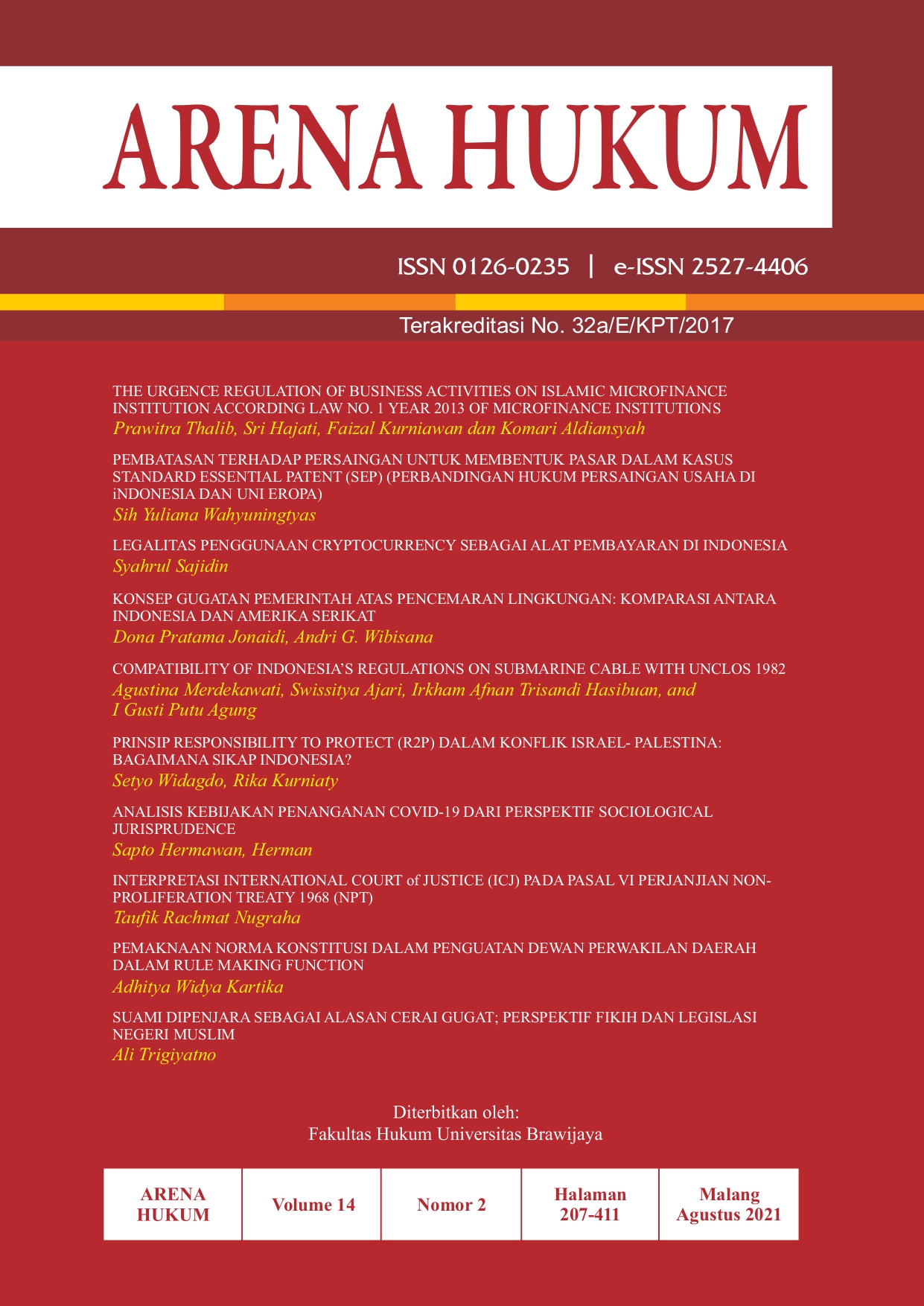
How to Cite
Widagdo, S., & Kurniaty, R. (2021). PRINSIP RESPONSIBILITY TO PROTECT (R2P) DALAM KONFLIK ISRAEL- PALESTINA: BAGAIMANA SIKAP INDONESIA?. Arena Hukum, 14(2), 314–327. https://doi.org/10.21776/ub.arenahukum.2021.01402.6
License
This journal embed or display simple machine-readable CC licensing information. This journal allow reuse and remixing of content in accordance with a Creative Commons license, Creative Commons Attribution-NonCommercial 4.0 International License (CC BY NC). This license (CC BY NC) allows other users to re-edit / rewrite and rebuild a work non-commercially as long as the user gives credit and licenses his new work in the same domain.
Authors who publish with this journal agree to the following terms:
- Authors retain copyright and grant the journal right of first publication with the work simultaneously licensed under a Creative Creative Commons Attribution-NonCommercial 4.0 International License (CC BY NC) that allows others to share the work with an acknowledgement of the work's authorship and initial publication in this journal.
- Authors are able to enter into separate, additional contractual arrangements for the non-exclusive distribution of the journal's published version of the work (e.g., post it to an institutional repository or publish it in a book), with an acknowledgement of its initial publication in this journal.
- Authors are permitted and encouraged to post their work online (e.g., in institutional repositories or on their website) prior to and during the submission process, as it can lead to productive exchanges, as well as earlier and greater citation of published work (See The Effect of Open Access).
Source: https://arenahukum.ub.ac.id/index.php/arena/article/view/1455
0 Response to "What Countries Continue to Resist Accepting the Responsibility to Protect"
Post a Comment